

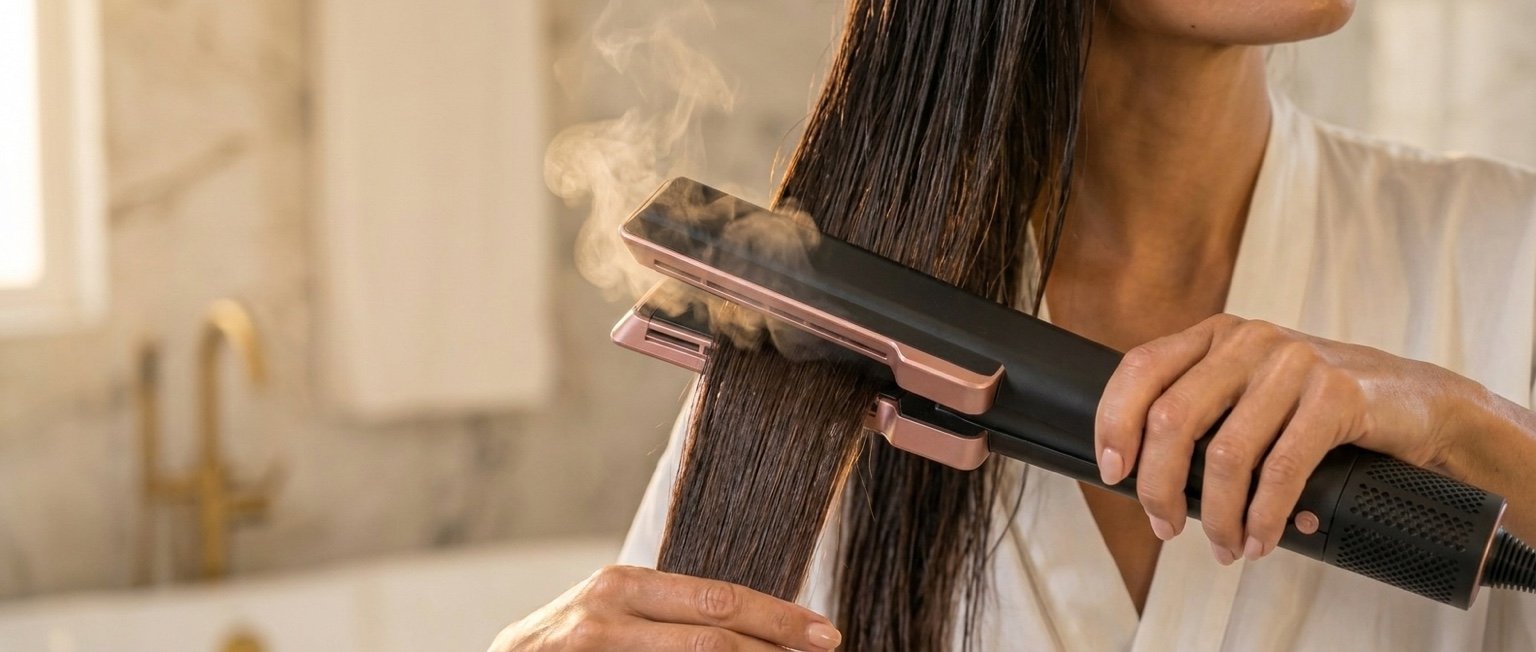
Short answer: it depends entirely on what you're straightening with.
With a regular flat iron — no. Straightening wet hair with a standard flat iron is one of the more damaging things you can do to it, and the effects compound over time. With a tool specifically engineered for wet-to-straight styling — yes, when used correctly.
The distinction matters because the mechanism of damage is specific, and understanding it makes clear why these two situations are not the same thing.
What Actually Happens When You Straighten Wet Hair
Hair is primarily made of keratin — a protein structure that forms each strand. When your hair is wet, that structure is weakened. The hydrogen bonds that hold the hair's shape temporarily break down in the presence of water, which is why wet hair stretches further before snapping and why it's more vulnerable to mechanical stress.
Apply a standard flat iron — which operates at 180–230°C — to wet hair, and two things happen simultaneously:
Internal steaming
The water trapped inside the hair shaft doesn't just evaporate. At those temperatures, it flash-boils. The resulting steam has nowhere to go — so it forces its way through the hair's outer cuticle layer. Under a microscope, this shows up as small bubbles within the hair shaft itself. That structural damage is permanent. The strand is weakened from the inside.
Cuticle disruption
The hair's outer cuticle — the overlapping scale-like layer that protects the cortex beneath — is forced open by the combination of moisture and intense heat. Once disrupted at this level, the cuticle doesn't lie flat again properly. The result over time is increased frizz, rough texture, split ends, and breakage that worsens with each subsequent styling session.
The cumulative effect is hair that progressively loses its integrity — not dramatically after one session, but noticeably after weeks or months of the same routine. Heat protectant reduces surface friction but cannot prevent internal steaming. It isn't designed to handle this specific combination of moisture and direct high-heat plate contact.

How a Wet-To-Straight Styler Works Differently
A wet-to-straight styler isn't a flat iron with a different name. It's a different category of tool, engineered specifically to handle damp hair without the damage mechanisms described above.
The FL!KT Wet-To-Straight Hair Styler uses an airflow-only design — no heating plates, no direct plate contact. Instead of clamping heated surfaces onto the hair shaft, it directs controlled airflow through the open arms at 11.2 m/s, drying and straightening simultaneously as you pass it through each section.
Because there's no plate contact, there's no flash-boiling of moisture trapped between a hot surface and a wet strand. The water is moved through airflow rather than superheated in place. That's the mechanical difference that makes it safe on towel-dried hair when a flat iron is not.
Three temperature settings — 80°C for fine hair, 120°C for everyday use, 140°C for thick or coarse hair — are significantly lower than a standard flat iron's operating range. Lower temperatures, no plate contact, and controlled airflow rather than static heat application. These aren't cosmetic differences.
By Hair Type: Risk vs Safe Approach
The risk profile varies by hair type. Here's how it breaks down:
| HAIR TYPE | REGULAR FLAT IRON ON WET HAIR | WET-TO-STRAIGHT STYLER | RECOMMENDED SETTING |
|---|---|---|---|
| Fine / Delicate | High risk — thin strands have less structural tolerance. Damage appears quickly. | Safe with correct technique and correct setting. | 80°C — lowest heat. Slow passes. |
| Wavy / Medium | Moderate-high risk — moisture trapped in waves compounds damage. | Good results. Requires sectioning and steady pace. | 120°C — everyday setting. |
| Thick / Coarse | High risk despite apparent resilience — internal steaming still occurs. | Best results of all hair types. Handles higher airflow well. | 140°C — maximum setting. |
| Colour-Treated | Very high risk — chemical processing has already compromised cuticle integrity. | Safer than flat iron. Use lower setting and heat protectant. | 80°C–120°C. Go slowly. |
| Curly / Coily | Extreme risk — tighter curl patterns trap more moisture. Damage is severe. | Works as a stretch and smooth tool. Realistic expectations needed. | 120°C. Small sections. Multiple passes. |
How Wet Is Too Wet?
This is where most mistakes happen, even with the right tool.
Towel-dried is the correct starting point — hair that's damp to the touch but not releasing water when squeezed. The FL!KT Wet-To-Straight Styler is designed for this moisture level. Starting with dripping or soaking wet hair puts unnecessary strain on any wet-to-straight tool and produces worse results: longer styling time, less definition, and more passes needed per section.
A practical test: if you can wring water from your hair, it's too wet. If it feels slightly cool and damp but not saturated, you're at the right starting point.
The airflow will handle the remaining moisture — that's what it's built to do. You don't need to pre-dry beyond towel-drying.
Using It Correctly: The Non-Negotiables
Even the right tool causes problems if used wrong. These are the things that actually matter:
Towel dry first
Remove excess water before you start. Microfibre towels are ideal — they absorb moisture without roughing up the cuticle the way a standard towel can. Blot rather than rub.
Select the right temperature
Fine or delicate hair: 80°C. Everyday use on medium thickness: 120°C. Thick or coarse hair: 140°C. Start lower and increase only if needed. The airflow system works at lower temperatures than a flat iron requires — don't compensate by going high.
Work in sections
Smaller sections produce better results with fewer passes. One slow, steady pass through a well-sectioned strand outperforms three rushed passes through too much hair at once.
Direction matters
Hold the styler so airflow is directed downwards — this smooths the cuticle rather than lifting it. Pass from root to end in a single controlled motion.
Use heat protectant
Lower temperatures and no plate contact significantly reduce the damage risk, but heat protectant still matters — particularly on colour-treated or previously damaged hair where the cuticle is already compromised. Use one formulated for damp hair.
The Botton Line
Straightening wet hair is not categorically unsafe — it depends on what you're straightening with and how you're doing it.
A standard flat iron on wet hair causes real, cumulative, structural damage. That's not a marketing claim — it's what the physics of trapped steam and high-temperature plate contact produces.
A wet-to-straight styler like the FL!KT Wet-To-Straight Hair Styler is a different tool for a different job. Airflow-only design. No plate contact. Temperatures matched to what damp hair can handle. Used correctly on towel-dried hair, it's a safe and effective way to cut your styling routine in half — without the damage that comes from using the wrong tool for it.
Share:
Multi-Styler vs Separate Hair Tools: Is It Worth It?
How to Add Volume to Fine Hair at Home