

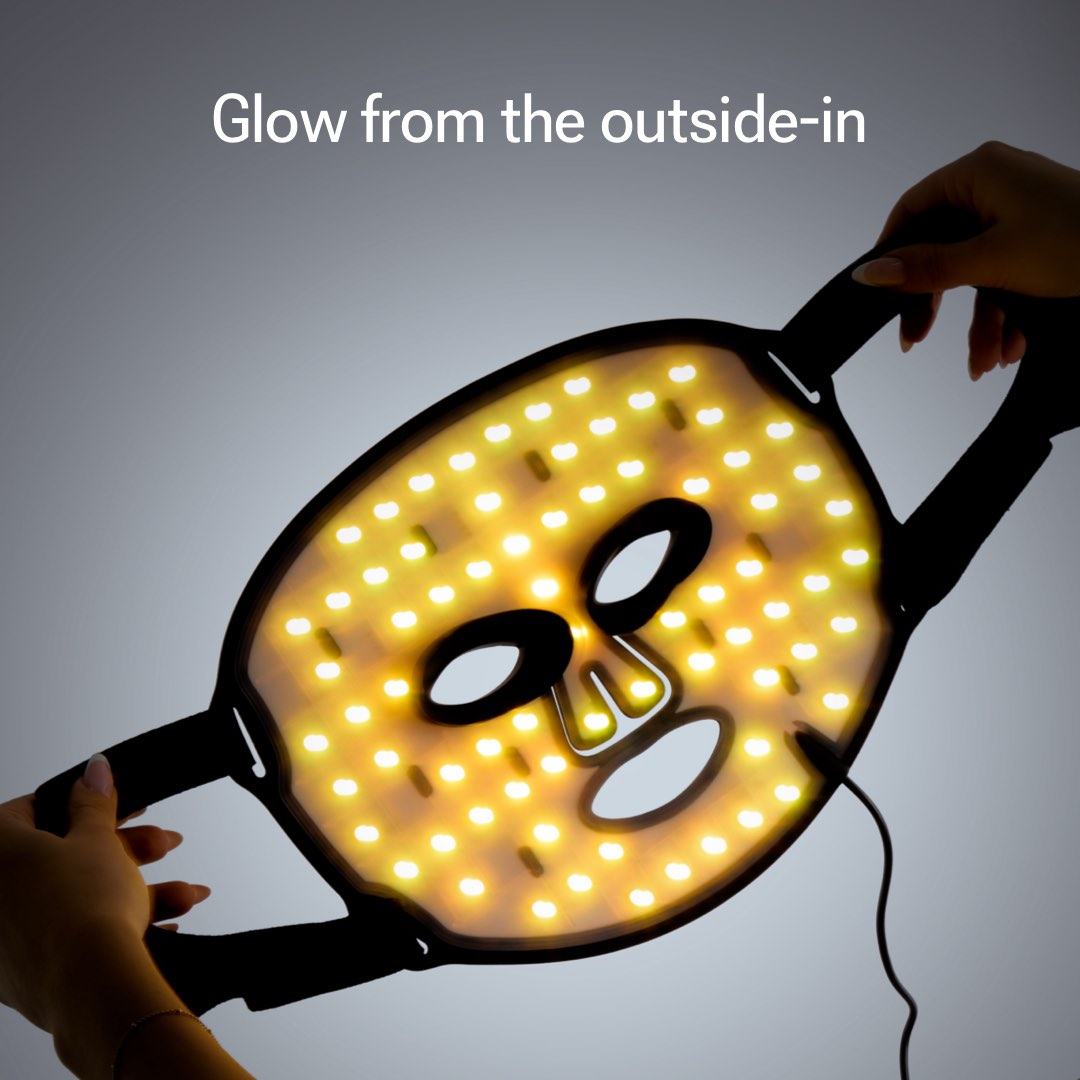
Everything you need to know about LED face masks — how they work, which wavelengths do what, and what results to realistically expect. Your no-BS guide to at-home light therapy.
LED face masks have gone from something you'd only see in a dermatologist's treatment room to a staple of serious skincare routines at home. And honestly? The science behind them is more convincing than most beauty tech you'll come across.
But there's also a lot of noise. Vague claims, confusing wavelength numbers, and devices that look the part without doing much. This guide cuts through all of it — explaining exactly what LED masks do, why they work, and what you can realistically expect from consistent use.
Whether you're looking to tackle early signs of ageing, calm breakout-prone skin, or just give your complexion a boost, this is the only resource you need.
Table of contents
What is an LED face mask, exactly?
An LED face mask is a wearable skincare device embedded with light-emitting diodes that emit specific wavelengths of light onto your skin. You wear it for 10–20 minutes at a time, a few times a week, and it gets to work stimulating your skin at a cellular level — no needles, no downtime, no heat damage.
The concept isn't new. Light therapy — or photobiomodulation — has been used in medical and clinical settings for decades. What's changed is that the technology has become small enough, affordable enough, and effective enough to bring home. And when you're using the right device with the right wavelengths at the right power density, the results are genuinely impressive.
Unlike many other beauty devices that create surface-level changes (peeling, tightening, temporary plumping), LED light therapy works from the inside out. The benefits build over time, which means the results also tend to last longer and look more natural.
The science: how light therapy works on skin
At its core, LED light therapy works through a process called photobiomodulation (PBM). It sounds complex, but the principle is straightforward: specific wavelengths of light are absorbed by receptors in your skin cells, triggering a cascade of biological responses that support repair, regeneration, and renewal.
The primary mechanism involves your cells' mitochondria — the powerhouses that produce ATP (cellular energy). When the right wavelengths of light hit the skin, they stimulate ATP production, which in turn boosts collagen and elastin synthesis, accelerates cellular repair, and reduces inflammation.
Research in this field spans over 30 years and thousands of peer-reviewed publications. The two wavelengths consistently shown to have the greatest effect on skin cells are 630nm (red light) and 850nm (near-infrared) — and these are the gold standard to look for in any serious LED device.
Wavelengths decoded: red, NIR, and blue
Not all light is created equal. Each wavelength penetrates the skin at a different depth and triggers different biological responses. Here's the breakdown:
Wavelength |
Penetration |
Primary Benefits |
Best For |
Red 630–660nm |
Epidermis & upper dermis |
Collagen & elastin stimulation, reduced inflammation, improved circulation |
Anti-ageing, fine lines, skin tone |
Near-Infrared 820–850nm |
Deep dermis & beyond |
Deeper healing, cellular repair, enhanced skin firmness |
Deeper wrinkles, recovery, overall rejuvenation |
Blue 415–470nm |
Surface layer only |
Destroys acne-causing bacteria, reduces oil gland activity |
Acne, breakout-prone skin |
The most effective at-home devices combine red and near-infrared as the core pairing — this is where the clinical evidence is strongest. Blue light adds anti-acne benefit. If you want a device that covers all bases, look for one that offers all three.
One important note: near-infrared light is invisible to the naked eye. If your mask lights up but you can't see the NIR wavelength, that's normal and expected — it doesn't mean it isn't working

What LED masks actually do for your skin
Stimulates collagen and elastin production
This is the big one for anti-ageing. Collagen is the protein responsible for keeping skin firm, plump, and elastic. From our mid-twenties, production naturally slows — and that's when fine lines, laxity, and texture changes start to appear. Red and near-infrared light directly stimulate the fibroblast cells that produce collagen, helping to reverse and slow this decline.
Reduces fine lines and wrinkles
Because LED therapy boosts collagen from within, it's one of the most effective non-invasive approaches for softening fine lines over time. Clinical data shows meaningful improvement in wrinkle depth and skin texture with consistent use over 8–12 weeks.
Targets acne and breakouts
Blue light at 415–470nm is clinically proven to destroy the bacteria (Cutibacterium acnes) that cause inflammatory acne, while also helping to regulate sebum production. For mild to moderate acne, this is a genuinely effective — and gentle — intervention.
Evens skin tone and reduces redness
Red light improves microcirculation, which supports a more even, radiant complexion. It also helps calm redness associated with rosacea and post-inflammatory marks. With consistent use, skin tends to look more balanced and luminous.
Supports skin healing and recovery
Near-infrared light in particular has powerful anti-inflammatory properties and supports faster cellular repair. This makes LED therapy excellent after any skin stress — whether that's a breakout, a cosmetic treatment, or environmental damage from sun exposure.
When to expect results — week by week
LED therapy is not an overnight fix. It works with your skin's natural regeneration cycle, which means patience and consistency are non-negotiable.
Week 1–2: Subtle shifts
Skin may feel calmer and slightly more balanced. Some users notice reduced redness and a gentle glow from improved circulation. Don't expect dramatic changes yet — the cellular work is happening beneath the surface.
Weeks 3–4: First visible results
Most users start noticing smoother texture and a more even skin tone. Acne-prone users often see a meaningful reduction in breakouts at this stage. This is when before-and-after photos start to tell a story.
Weeks 4–8: Noticeable transformation
Firmness increases as collagen production ramps up. Fine lines begin to soften. Clinical research has observed around 31% higher collagen levels after eight weeks of regular use. Skin looks genuinely healthier.
Weeks 8–12: Deep results
For anti-ageing goals, this is where the most significant changes occur — wrinkle reduction, improved elasticity, and lasting improvement in overall skin quality. Clinical trials show up to 38% less crow's feet depth at this stage.
12 weeks+: Maintenance
Most people transition to a maintenance routine of 2–3 sessions per week. Benefits can persist for 1–4 months after stopping treatment, and continued use keeps results building.
How to use an LED mask properly
Getting the most from your FL!KT LED Face Mask comes down to a few simple habits:
- Cleanse first. Always start with clean, dry skin — makeup, SPF, and oils all block light penetration. A gentle cleanser is all you need.
- Skip the serum before. Use your LED mask before applying serums or moisturiser. Apply skincare after your session to lock in the benefits.
- 10–20 minutes per session. This is the clinical sweet spot. More time does not mean more results — the skin processes a finite amount of light energy per session.
- 3–5 sessions per week. Consistency beats intensity. Three to five sessions weekly is ideal; every day isn't necessary and won't speed things up.
- Stay consistent for 8+ weeks. Give yourself a genuine trial period before judging results. Take weekly photos — progress is often more visible in comparison.
- Eye protection. Close your eyes during sessions, or use the included eye inserts. While LED light isn't UV, it's bright enough to cause discomfort with prolonged direct exposure.
- No downtime needed. You can apply makeup, go to work, or go to bed immediately after. LED therapy is completely non-invasive.
Is an LED mask right for you?
LED face masks are suitable for virtually all skin types — including sensitive skin. The light is non-UV, produces no heat, and involves no chemicals or abrasion. There's no redness, no peeling, and no recovery time.
They work particularly well for:
- Anyone looking to support collagen production and slow the visible signs of ageing.
- Those dealing with mild to moderate acne or consistently congested skin.
- People with redness, rosacea, or post-inflammatory pigmentation.
- Anyone who's tried topical skincare but wants to add a technology-led layer to their routine.
The main contraindications are photosensitive skin conditions, certain medications that cause light sensitivity (check with your GP or dermatologist), active epilepsy (due to flashing lights), and pregnancy — where caution is generally advised as a precaution. If you're unsure, a quick conversation with your dermatologist will give you a clear answer.
Frequently asked questions
How long does it take to see results from an LED face mask?
Most people notice smoother texture and improved skin tone within 3–4 weeks of consistent use (3–5 sessions per week). Deeper changes — like improved firmness and reduced fine lines — typically appear at 6–8 weeks. For significant anti-ageing results, give it a full 12-week trial.
How often should I use my LED face mask?
3–5 times per week is the clinical sweet spot for at-home devices. Daily use isn't necessary and won't accelerate results — your skin needs recovery time between sessions to complete its repair processes.
Can I use an LED mask every day?
Yes, daily use is generally safe — but there's no evidence it's more effective than 3–5 times weekly. Many users find that skipping days improves compliance long-term, as it doesn't feel like a chore.
What wavelength should I look for in an LED face mask?
For anti-ageing benefits, look for red light at 630–660nm and near-infrared (NIR) at 820–850nm. If you also want to target acne, blue light at 415–470nm is the addition to look for. Avoid devices that don't disclose their wavelengths
Do LED face masks actually work?
Yes — when you're using a device with the right wavelengths, adequate power density, and consistent usage. Photobiomodulation has decades of clinical research behind it. The key is realistic expectations: LED therapy builds results gradually rather than delivering instant transformation.
Are LED face masks safe for sensitive skin?
Yes. LED light therapy is non-UV, produces no heat, and involves no chemicals. It's one of the gentlest skincare technologies available and is suitable for sensitive and reactive skin types. If you have a photosensitive skin condition or take medication that causes light sensitivity, check with your doctor first.
Can I use an LED mask with my other skincare products?
Yes — use the mask on clean, dry skin before applying serums and moisturisers. Applying your skincare after an LED session can actually enhance absorption, as blood circulation to the skin is temporarily increased. Avoid applying active ingredients like retinol immediately before a session.
How long do LED face mask results last?
Benefits can persist for 1–4 months after stopping treatment, but collagen production and skin health are ongoing processes that benefit from maintenance. Most people settle into a long-term routine of 2–3 sessions per week to sustain and build on their results.
Share:
Wet-to-Dry Hair Straighteners: Everything You Need to Know
How to Use a 6-in-1 Hair Multi-Styler: The Complete Guide to Every Attachment